

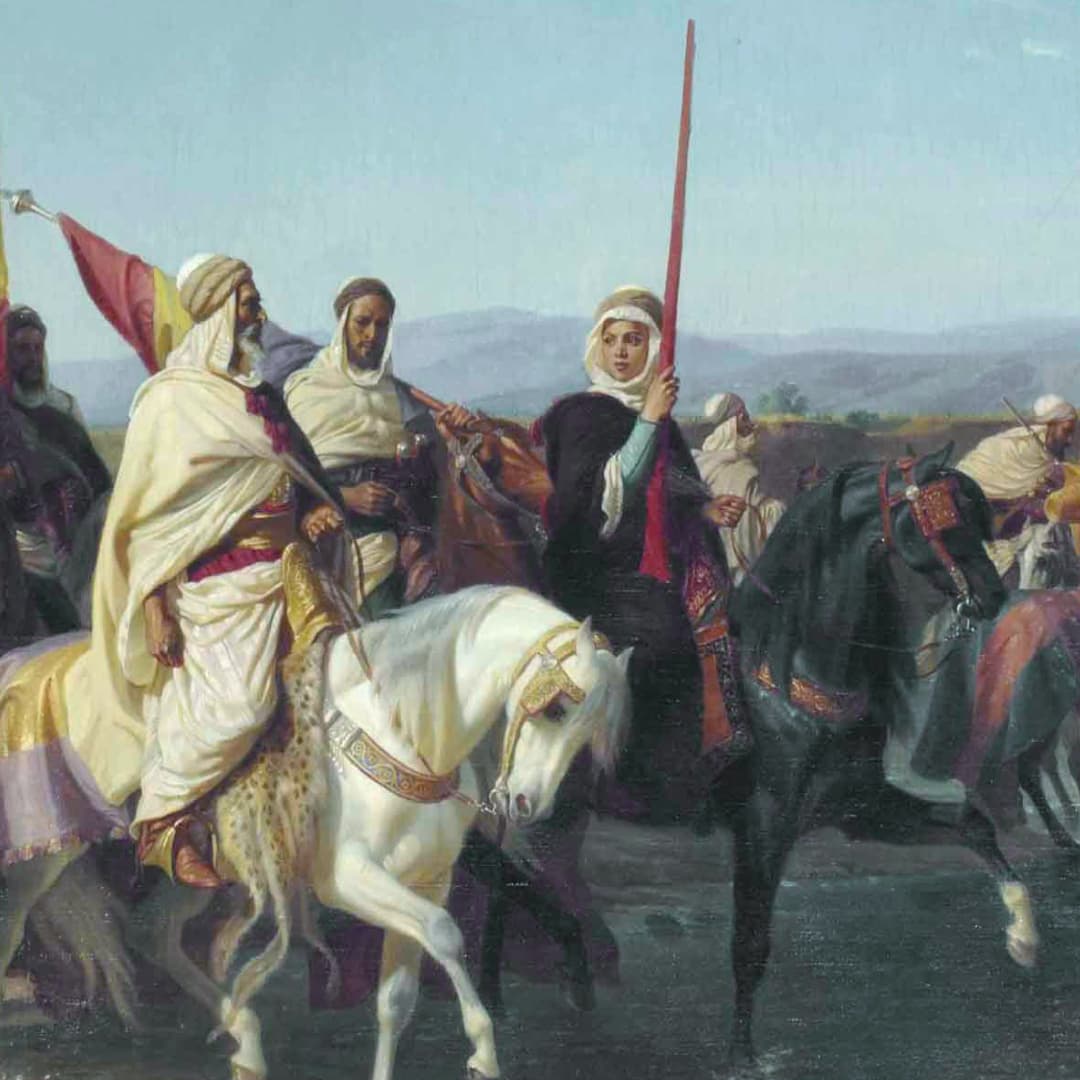
An Algerian national heroine, Lalla Fatma N’Soumer (1830–1863) is remembered for the defeats she inflicted upon the French army. Both military leader and holy woman, she inspired great devotion among her followers. She remains today a symbol of resistance against colonialism.
Lalla Fatma N’Soumer: a Kabyle holy woman
Lalla Fatma N’Soumer, or Fadhma according to the Kabyle pronunciation of her name, was born in Ouerdja. Her father was a renowned religious leader and teacher. From a young age, she was drawn to mysticism and meditation and memorized the Qur’an by heart. At the age of sixteen, she was married to her cousin but ended the union to focus on her spiritual journey.
Lalla Fatma became active and influential in traditionally male-dominated religious and political spheres. She was therefore given the honorific title of “Lalla,” which denotes a woman of distinction.
A muslim warrior woman fighting for Algeria’s freedom
As the French army threatened to conquer the region of Kabylie, Lalla Fatma used her religious authority to build a structured resistance movement and mobilised an army of men and women. In 1849, she allied herself with the religious and independence leader Si Mohammed El-Hachemi. She and her brother were granted authorization to lead the Imseblen, the “volunteers of death.”
Lalla Fatma N’Soumer was believed to be a prophetess. A strict commander, she did not tolerate slackness or cowardice. Soldiers who tried to flee the enemy were burned with a poker.
In 1854, her troops defeated the French army under General Randon in battle. Although the French forces had superior numbers and equipment, the Kabyle troops prevailed after two months of fighting.

Depiction of a Kabyle woman during Lalla Fatma’s time
Her story brings to mind the exploits of warrior queens from the Aurès Mountains, such as al-Kahina in the 7th century or Fatma Tazoughert, “the Redhead,” in the 16th century. Both women were also regarded as holy women and prophetesses
As of 1854, the region was still independent and remained, for a time, the last bastion in Algeria free from French rule.
An Algerian national heroine and symbol of resistance against colonialism
By 1857, General Randon returned, determined to crush the Kabyle resistance. Lalla Fatma organized the defense. In spite of her people’s bravery, she was ultimately captured. From the moment she fell into the enemy’s hands, all resistance ceased.
She was placed in detention under French authority and died six years later at the age of thirty-three. She later became a symbol of the fight for Algeria’s independence. In 1999, her remains were transferred to the Martyrs’ Cemetery of El Alia in Algiers. Her legacy was also mobilized by feminist movements.
Today, the Kabyle expression “Lalla n’Ouerdja,” a name also attributed to Lalla Fatma, designates a woman who refuses to conform to traditional gender roles.

I run this project on a voluntary basis because I think these women’s stories deserve to be told. My goal is to build a comprehensive online archive to safeguard this heritage.
Hours of research hide behind each post. My content is human-written, without AI-Generated visuals.
To help me continue this project or to show you appreciation, please consider donating to my Ko-Fi!
Further reading and bibliography about Lalla Fatma N’Soumer
Boudjadja Meriem, “Lalla Fatma N’Soumer”, in: Amazones, Femmes de cheval chez tous les peuples de la terre, depuis les temps les plus anciens jusqu’à nos jours
Benbrahim Malha, “Documents sur Fadhma N’Soumeur (1830-1861)”
Carrey Emile, Récits de Kabylie
Chitour Chems Eddine, L’Histoire de l’Algérie, De la résilience à la quête de la modernité
Smail Salhi Zahia, “Nsoumer, Fatma”, in: Dictionnary of African Biography
Sign up so you don’t miss any of the new articles!
Leave a comment