

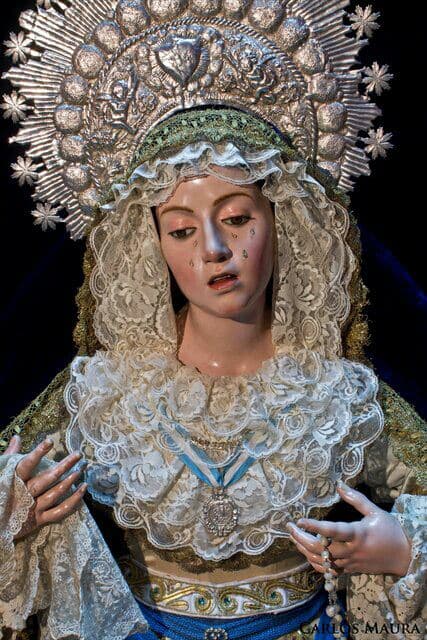
Luisa Roldán, known as La Roldana (1652–1706), was one of the greatest sculptors of the Spanish Baroque. She became a court sculptor and amazed her contemporaries with the quality of her work.
Luisa Roldán: from her father’s apprentice to independent woman sculptor
Like many women artists of her time, Luisa Roldán came from an artistic family and learned her craft in the family workshop. Her father ,Pedro Roldán, was a sculptor who specialized in polychrome religious sculptures carved from wood. She trained alongside her siblings, including her sisters María and Francisca.
She later fell in love with Luis Antonio de los Arcos, one of her father’s apprentices. Determined to marry him despite her father’s opposition, Luisa appealed to the church authorities and married him in 1671. With her departure, Pedro lost one of the most gifted artists in his workshop, which was likely the main reason he had opposed the marriage. Luisa and her husband would have seven children, although only two survived infancy.
One of the most famous artists of her time: court sculptor
In 1677, the couple began receiving commissions of their own and opened their own workshop. Luisa soon emerged as its principal sculptor, eclipsing her husband. Unlike many women from artistic dynasties, she gained recognition under her own name rather than remaining an anonymous assistant in the family business. The couple later moved to Madrid, where Luisa found a broader stage for her talent.
She applied to Charles II of Spain for the position of Escultor de Cámara (Court Sculptor). Four years later, she obtained the appointment and created two magnificent wooden sculptures for the king and his wife. Despite this prestigious position, she struggled both to secure and collect her salary because of the severe financial difficulties affecting Spain at the time. She repeatedly petitioned the monarchs, stressing her need to provide for her children. On one occasion, the queen replied: “Give her twenty-five doubloons this time.“The wording suggests that her financial difficulties were an ongoing concern.
After Charles II’s death in 1700, Luisa Roldán entered the service of his successor, Philip V. To secure his patronage, she presented him with a luxurious work of art intended to adorn one of his residences. She remained his court sculptor until her death in 1706.


A beloved Baroque sculptor: stunning terracottas and religious subjects
Since royal patronage did not guarantee financial security, Luisa turned to producing small-scale terracotta devotional sculptures. It was a wise decision, as there was strong demand among churches, convents, aristocrats, and private collectors. Her works were acquired by religious institutions, where they could be displayed on altars or in sacristies, as well as by wealthy individuals, who often placed them in private chapels or domestic interiors.
During her lifetime, Luisa’s work enjoyed considerable critical acclaim, particularly at court. Her lifelike baroque sculptures inspired devotion through their remarkable realism. She demonstrated an exceptional mastery of composition and imbued her figures with warmth and tenderness, skillfully blending sacred and profane.
Today, Luisa Roldán remains one of the most internationally celebrated and collected artists of the Spanish Baroque. She offers a remarkable example of a woman sculptor who won acclaim under her own name.

I run this project on a voluntary basis because these women’s stories deserve to be told. My goal is to build a comprehensive online archive to safeguard this heritage.
Hours of research hide behind each post. My content is human-written, without AI-Generated visuals.
To help me continue this project or to show you appreciation, please consider donating to my Ko-Fi!
Further reading and bibliography about Luisa Roldán
Dabbs Julia K., Life Stories of Women Artists, 1550–1800: An Anthology
De Girolami Cheney Liana, “Luisa Ignacia Roldán “La Roldana”: New Attributions to the First Sculptress of Spain, 1652-1706”
Gardonio-Foat Casey, “Daughters of Seville : workshops and women artists in early modern Andalucia”
Kinnaird Jennifer, “Gros plan sur Luisa Roldán”
Lenaghan Patrick, “Luisa Roldán: Court Sculptor to the Kings of Spain”
Sign up so you don’t miss any of the new articles!
Leave a comment