

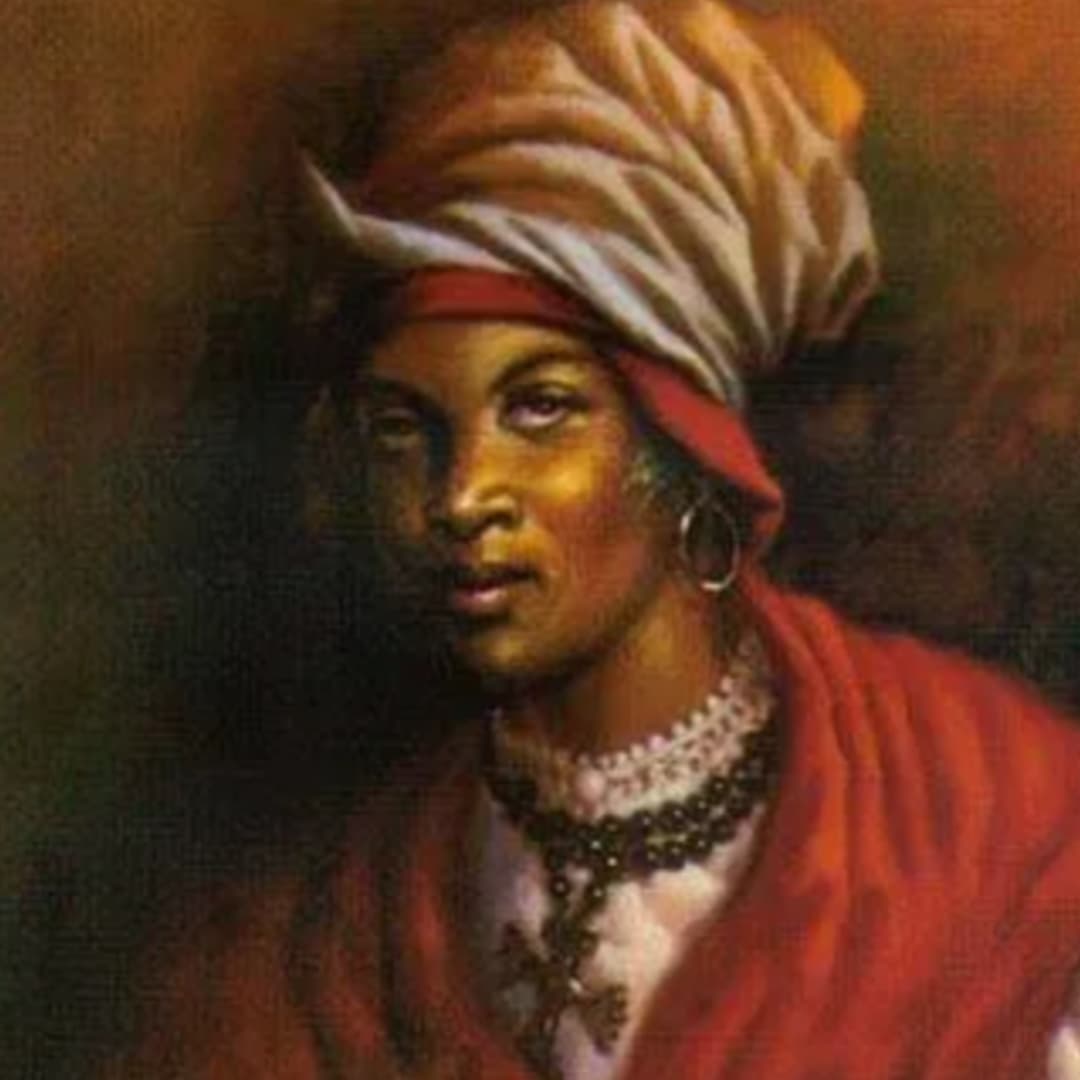
A mambo, or Vodou priestess, Cécile Fatiman (1771–1883) conducted the ceremony that sparked the Haitian Revolution. This revolt later inspired a number of slave uprisings across the America.
Cécile Fatiman’s life before the Haitian revolution
Cécile’s mother was an enslaved Black woman, and her father was described as a “Corsican prince,” which suggests that he may have been the son of Theodor Stephan von Neuhoff, who briefly ruled Corsica.
Cécile Fatiman had green eyes and long, silky black hair. She had two brothers but was separated from them when she and her mother were sold and brought to Saint-Domingue. It is unclear whether Cécile was already free when she conducted the ceremony. If not, she likely gained her freedom during or after the revolution.
The Bois-Caïman ceremony: the event that sparked the Haitian revolution
On August 14 or 21, 1791, Cécile officiated at the Bois-Caïman, literally “Caiman Wood”, ceremony. This event is considered the catalyst for the slave uprisings that led to the Haitian Revolution. Around two hundred enslaved people attended and took an oath of secrecy.
Cécile officiated alongside another leader, Dutty Boukman. She is often presented as his assistant. However, as a mambo, she likely played an equally important role in conducting the ceremony.
Dutty Boukman delivered a powerful speech, while Cécile invoked the lwa and sacrificed a black pig. According to tradition, she fell into a trance and was possessed by Erzulie, a spirit associated, among other things, with the protection of women. The ceremony called on the participants to unite and rise up against slavery, highlighting the central role of religious practices in the revolution that followed.
Accounts of the ceremony have portrayed it as barbaric and unsettling. Yet for the slaves who took part, it offered the possibility of emancipation and transcendence through dance, sacrifice, and spirit possession. For Cécile Fatiman, this implied an expanded sense of self and power.
The Haitian Revolution’s impact on slave uprisings
After years of struggle, the Haitian Revolution led to the creation of an independent Haitian state in 1804. It marked a profound shift and inspired further slave uprisings across the Americas, from Venezuela to Charleston and Cuba. The Bois-Caïman ceremony was thus immortalised as a deeply symbolic event.
As for Cécile, she married Jean-Louis Michel Pierrot, a respected general who later became President of Haiti from 1845 to 1846. Though she later divorced him, they had at least one child together, as her descendants later recounted her story.
She died at the age of 112 in full possession of her mental faculties.
Today, Cécile Fatiman is celebrated as a heroine of Haitian independence. She also appeared in the animated series Castlevania: Nocturne.

I run this project on a voluntary basis because I think these women’s stories deserve to be told. My goal is to build a comprehensive online archive to safeguard this heritage.
Hours of research hide behind each post. My content is human-written, without AI-Generated visuals.
To help me continue this project or to show you appreciation, please consider donating to my Ko-Fi!
Further reading and bibliography about Cécile Fatiman
Dayan Colin, Haiti, History and the Gods
Dubois Laurent, Avengers of the New World. The story of the Haitian Revolution
Finch Aisa K., “Cécile Fatiman and Petra Carabalí, Late Eighteenth-Century Haiti and Mid-Nineteenth-Century Cuba”, in: As if she were free, A Collective Biography of Women and Emancipation in the Americas
Sign up so you don’t miss any of the new articles!
Leave a comment