

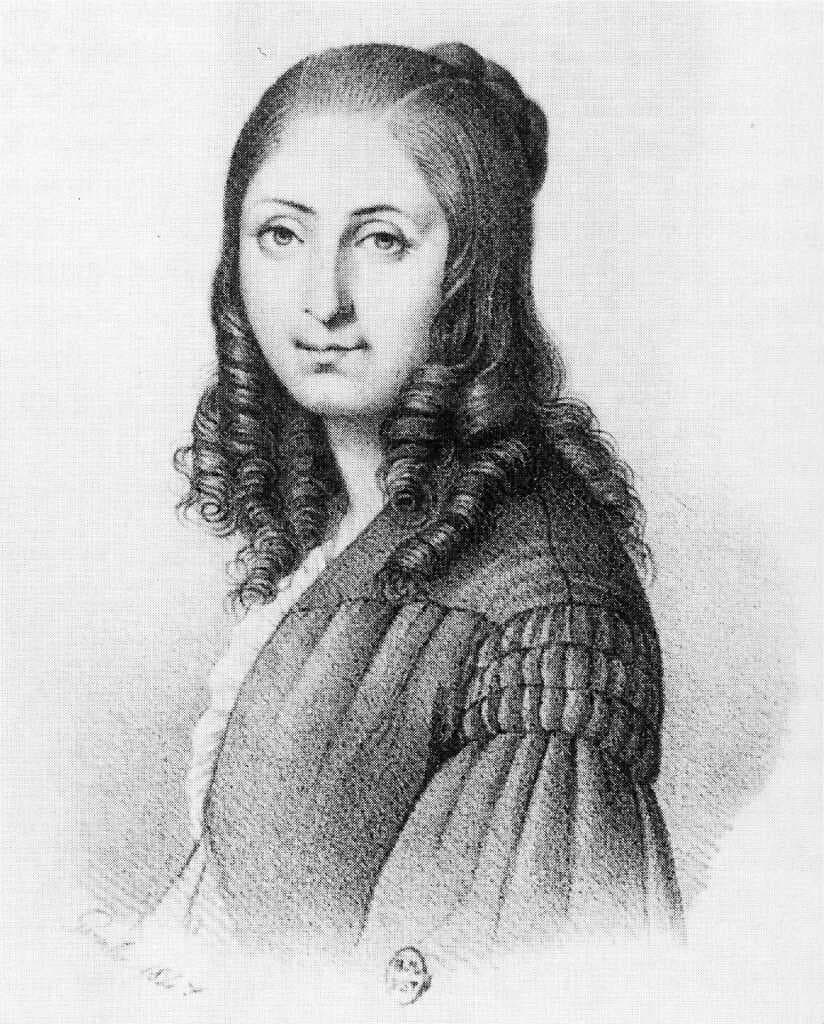
Flora Tristan (1803–1844) was a pioneer in the fight for women’s and workers’ rights. She was one of the first to believe that workers should be able to emancipate themselves. This indefatigable traveler also left behind a significant body of literary work.
Flora Tristan’s early years: the peregrinations of a pariah
Flora Tristan’s mother, Anne-Pierre de Laisnay, had taken refuge in Bilbao to escape the French Revolution. There, she met a Peruvian aristocrat, Mariano de Tristan y Moscoso. The two married in a religious ceremony and later settled in France, but the union was never properly registered with the French authorities.
In 1807, Mariano died, leaving Flora fatherless. Things quickly took a turn for the worse. Since France was at war with Spain, the French government confiscated their house, which was considered Spanish property. Anne-Pierre then sought refuge in the countryside and later moved to Paris under difficult circumstances.
Flora thus grew up between two worlds. Her mother glorified her family’s aristocratic past, but their present was devoid of luxury or grandeur. Flora was deeply burdened by her status as an illegitimate child and began to strongly identify with the figure of the pariah.
In 1821, under heavy pressure from her mother, Flora married a man she did not love: André Chazal, the owner of the workshop where she worked as a colorist. Although she would later forgive her mother, Flora resented her deeply. Married life was a nightmare. Chazal was abusive and heavily indebted. In 1825, Flora, pregnant with her daughter Aline, took her son Ernest and sought refuge with her mother.
Fleeing an abusive marriage when divorce was forbidden
To protect her children, Flora fled Paris. Pretending to be a widow, she took on various jobs, working as a shop assistant in a candy store and as a maid for wealthy English women. Since divorce had been abolished in 1816, she had few legal means to defend herself against Chazal. Still, Flora did not give up. Around that time, she contacted her father’s Peruvian relatives and managed to obtain a modest inheritance.
In 1832, Flora finally obtained a legal separation from Chazal, though she had to relinquish custody of her son Ernest. Soon after, Chazal publicly assaulted her, demanding that she hand over their daughter Aline. Flora barely escaped and went into hiding once more. After finding a safe place for Aline, she set her sights on new horizons.
Flora’s journey to Peru and travel writings
In 1833, Flora crossed the ocean to Valparaíso, hoping to reconnect with her father’s family and gain proper recognition. Though her uncle Pío welcomed her, she did not find what she sought. She secured part of her inheritance but realized she would never be anything more than her father’s illegitimate daughter.
During her stay, Flora traveled extensively through Arequipa and Lima. These explorations became the foundation of one of her most famous works, Peregrinations of a Pariah. In it, she expressed her commitment to revealing women’s unique experiences, giving voice to everyone from nuns to camp followers. This would mark the birth of her feminist engagement.
In 1834, Flora returned to France, but Chazal was waiting for her, and the battle began anew.
Novels, articles and the battle for divorce
Upon learning that Flora had inherited a considerable sum, Chazal abducted Aline and demanded a ransom. Again and again, he tried to separate Flora from her daughter. Flora fought tooth and nail, even as the legal system worked against her. Only after Aline accused her father of incest did things begin to turn in their favor. In a final act of violence, Chazal ambushed Flora in the street and shot her. She survived, and he was sentenced to forced labor.
At the same time, Flora Tristan made her literary debut. In 1836, she published a work highlighting the challenges faced by foreign women and the need to protect them. She soon carved a place for herself within the literary and intellectual circles of her time. She wrote on a wide range of topics, from art to travel writing ,and published a novel, Méphis, in 1838.
Flora was a shrewd businesswoman who knew how to grow her wealth and, most importantly, how to assert herself before publishers to ensure her rights were respected and her manuscripts properly handled.
A 19th century feminist and champion of worker’s rights
Two causes were especially dear to Flora: the rights of workers and women. She advocated for the legalization of divorce and the abolition of the death penalty. She was close to early women’s rights networks and refused to wear a corset.
In 1839, Flora traveled to London. Acting like an investigative journalist, she visited factories and impoverished neighborhoods, documenting the brutal realities of working-class life. She denounced the human cost of capitalism and the way it reduced workers to machines. In her work Promenades in London, Flora painted one of the most striking portraits of her time. Despite her Anglophobia, the book was well received in England and sparked public debate in France.
The emancipation of workers should come from workers themselves
Flora continued to advocate for women’s education, which she saw as the key to freeing women from subjugation and enabling them to earn better wages, thus becoming partners rather than subordinates.
In 1843, she published The Workers’ Union. She was among the first to believe that the emancipation of the working class must come from the workers themselves. To promote this idea, Flora undertook a tour of France in 1844. She met with factory workers, journalists, and influential figures of her era. During this tour, she met a young laundress named Éléonore Blanc, who became her “spiritual daughter,” and whose education she supported.
Flora spared no effort. Sometimes she was warmly welcomed; other times, she was rejected. Yet she persisted until her body could no longer bear it. She fell ill and died in Bordeaux in 1844. After her death, even her adversaries paid her homage.

I run this project on a voluntary basis because I think these women’s stories deserve to be told. My goal is to build a comprehensive online archive to safeguard this heritage.
Hours of research hide behind each post. My content is human-written, without AI-Generated visuals.
To help me continue this project or to show you appreciation, please consider donating to my Ko-Fi!
Further reading and bibliography about Flora Tristan
Dijkstra Sandra, Flora Tristan
Krulic Brigitte, Flora Tristan
“Flora Tristan”, Maitron
Sign up so you don’t miss any of the new articles!
Leave a comment