

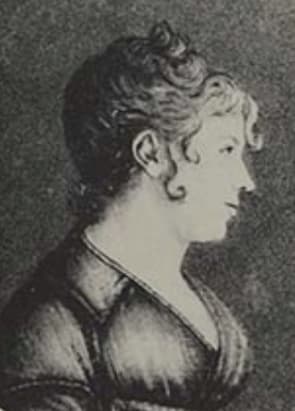
Rose de Freycinet (1794–1832) joined her husband on a maritime expedition around the world. Despite the many dangers she faced, she showed remarkable fortitude throughout the journey.
Rose de Freycinet’s quiet life before her adventures
Rose de Freycinet was born on September 29, 1794, in Saint-Julien-du-Sault. Her mother was a teacher who ran a boarding school for young ladies. Regarded as a woman of strong principles, she managed her institution with great efficiency.
Rose likely benefited from this scholarly environment and received a solid education. Her diaries reveal a broad literary culture as well as a knowledge of Italian. By the end of her voyage, she was also able to read English fluently.
In 1814, Rose married the aristocrat Louis-Claude de Saulces de Freycinet. She was nineteen years old, while he was thirty-five. Rose quickly charmed her in-laws and became deeply appreciated by them.
Woman sailor: stowing away disguised as a man
In 1817, Louis was tasked by the king with leading a circumnavigation of the globe that also served as a scientific expedition. Rose was not permitted to accompany him, but she refused to be separated from her husband. Together, they devised a solution: Rose boarded the ship Uranie disguised as a man.
Rose justified this unconventional decision through the traditional ideal of marital devotion. She believed it was her duty to devote herself to her husband and follow him wherever he went. The authorities were informed of her presence on board and promised to investigate the matter. King Louis XVIII, however, proved lenient. Rose’s example was unlikely to inspire a wave of imitators.
Once the expedition reached Gibraltar, Rose abandoned her disguise. The presence of this woman sailor had never truly been a secret. Almost everyone on board had known from the beginning.
Part of the crew: attitudes towards women at sea
At sea, Rose acted as a hostess for the officers and cared for sick crew members, who were sometimes numerous. During her free time, she followed a structured routine: one hour playing the guitar, one hour devoted to needlework, another to studying English, and a final hour writing in her diary. Rose recorded her experiences in a journal addressed to her cousin, Caroline de Nanteuil. A deeply religious woman, she also attended Mass every Sunday.
The voyage was filled with dangers. At the beginning of the expedition, the Uranie was pursued by an Algerian privateer. Then came storms, extreme heat, and shortages of drinking water. Fortunately, Rose suffered little from seasickness.
Although she was the only woman on board, her presence appears to have caused little friction. The officers treated her with courtesy. Some even offered emotional support, such as the senior surgeon who spent an hour comforting her during a storm. Rose did not often come on deck, but when she did, the crew made room for her and the sailors refrained from singing bawdy songs. Overall, she was admired for her intelligence and strength of character.
The campaign of the Uranie: Rose explores and discovers
During stopovers, Rose enjoyed social gatherings and was sometimes treated like a heroine. Interestingly, she met another seafaring woman during one of these stays. The woman was the wife of an English frigate captain and travelled alongside her husband while he carried out a military mission protecting merchant ships. The two women bonded over their shared experiences.
Rose carefully recorded her observations in her diaries, paying close attention to local customs and describing her encounters with Indigenous peoples. Although she occasionally reflected the prejudices of her time, she remained curious and observant.
An amateur naturalist, Rose collected specimens during her travels. She also conducted her own observations of birds, insects, seashells, and minerals. She notably drew a giant manta ray she had discovered. During the expedition, her husband gave her name to a small island in the Pacific Ocean.

Shipwreck and peril: the making of a heroine
Disaster struck when the Uranie was wrecked in the Falkland Islands after hitting a hidden reef. At first, Rose was terrified and deeply concerned for her husband. Jacques Arago, the expedition’s artist, sought to reassure her:
“But do not worry. If some misfortune were to befall you, madam, and you were destined to outlive your husband, these men, madam, would not only respect you as one respects a virtuous woman, but would throw themselves at your feet as one throws oneself at the feet of the Blessed Virgin! Take heart. I have brought you some help, or at least some brandy.”
Rose soon demonstrated extraordinary courage. She endured harsh weather and difficult living conditions on land. The cold proved especially challenging after so many months spent in warmer climates. Determined to maintain some sense of normality, she organized her tent, arranged a makeshift bed, inventoried the food supplies, and baked bread, all while caring for her sick husband.
Rescue finally arrived in the form of an American whaling ship. Once again, Rose took on the role of hostess. Nevertheless, she was heartbroken at the prospect of abandoning the Uranie.
Louis eventually purchased the vessel that had rescued them and renamed it La Physicienne. As he remained ill, Rose also helped by writing the letters he dictated.
The last journey: Rose’s return to France and death
In 1820, Rose finally set foot in France again. The expedition was considered a scientific success. Friends and acquaintances noted that she had become more serious and reserved. Although Rose was absent from most official reports, eyewitness accounts and her own writings reveal the importance of her contribution. She had become one of the first women to circumnavigate the world.
Looking back on her adventures, Rose declared that she had no regrets, for she had been able to brighten her husband’s daily life. Indeed, she believed she would have regretted not accompanying him. She even admitted that, had she been younger, she might not have opposed the idea of embarking on another voyage.
After surviving so many dangers at sea, Rose de Freycinet died during a cholera epidemic in 1832. Louis followed her in death in 1849.

I run this project on a voluntary basis because I think these women’s stories deserve to be told. My goal is to build a comprehensive online archive to safeguard this heritage.
Hours of research hide behind each post. My content is human-written, without AI-Generated visuals.
To help me continue this project or to show you appreciation, please consider donating to my Ko-Fi!
Further reading and bibliography about Rose de Freycinet
De Freycinet Rose, La campagne de l’Uranie 1817-1820
De Freycinet Rose, Rivière Marc Serge (trad.), A Woman of Courage, The Journal of Rose de Freycinet on Her Voyage Around the World, 1817-1820
Léonard-Roques Véronique, “Les écrits viatiques de Rose de Freycinet : regard d’une voyageuse hors norme sur son tour du monde à bord de L’Uranie (1817-1820)”
Meure Chantal, “Une aventure ambiguë,Le voyage autour du monde de Rose de Freycinet (1817-1820)”, in: Les voyageuses de l’Océan Indien
“Rose de Freycinet”, Histoire et Patrimoine Seynois
Sign up so you don’t miss any of the new articles!
Leave a comment